Friday, June 24, 2011

Gubbio and bird cage mountain lifts


After Venice, we traveled to Gubbio. Gubbio is in Umbria and Umbria is a quiet part of Italy with hills and orchards and mountains. It was a five hour train ride/bus ride. On the train, I had packed a bottle of pesto and bread and cheese for the journey. And, much to my horror, the pesto jar leaked all over my belongings in my green travel bag. Train washrooms don't have running water and there were no paper towels either, so I wasn't quite sure how to rectify the situation. I decided to be methodical about it all. So I pulled out one of my scarves, a scarf of no particular value to me, and one at a time, I began to clean the green oily mixture off of everything in my hand bag. Eventually, a fellow traveler- a traveler prepared for all occasions- gave me handi-wipes. (And handy they were!) Needless to say, my romantic idea of having a picnic lunch on the train while reading my Charlotte Bronte novel, did not pan out. However, I did smell like a delicious plate of pasta by the time I arrived in Gubbio.


We tasted the most incredible food in Gubbio. This medieval town, with its grey foot stones, is known for its truffles. The chef at the restaurant offered to give us a plate with a little taste of this and a little taste of that (all from the "primo" section of the menu. I do not think I have tasted anything so delicious in my entire life. Don't ask me to tell you what the items were. All I can say is they had bits of black truffle in them and that the name of the restaurant was La Cantina. The next night, we ate in an equally delicious restaurant. The entire town is saturated with amazing chefs and food.


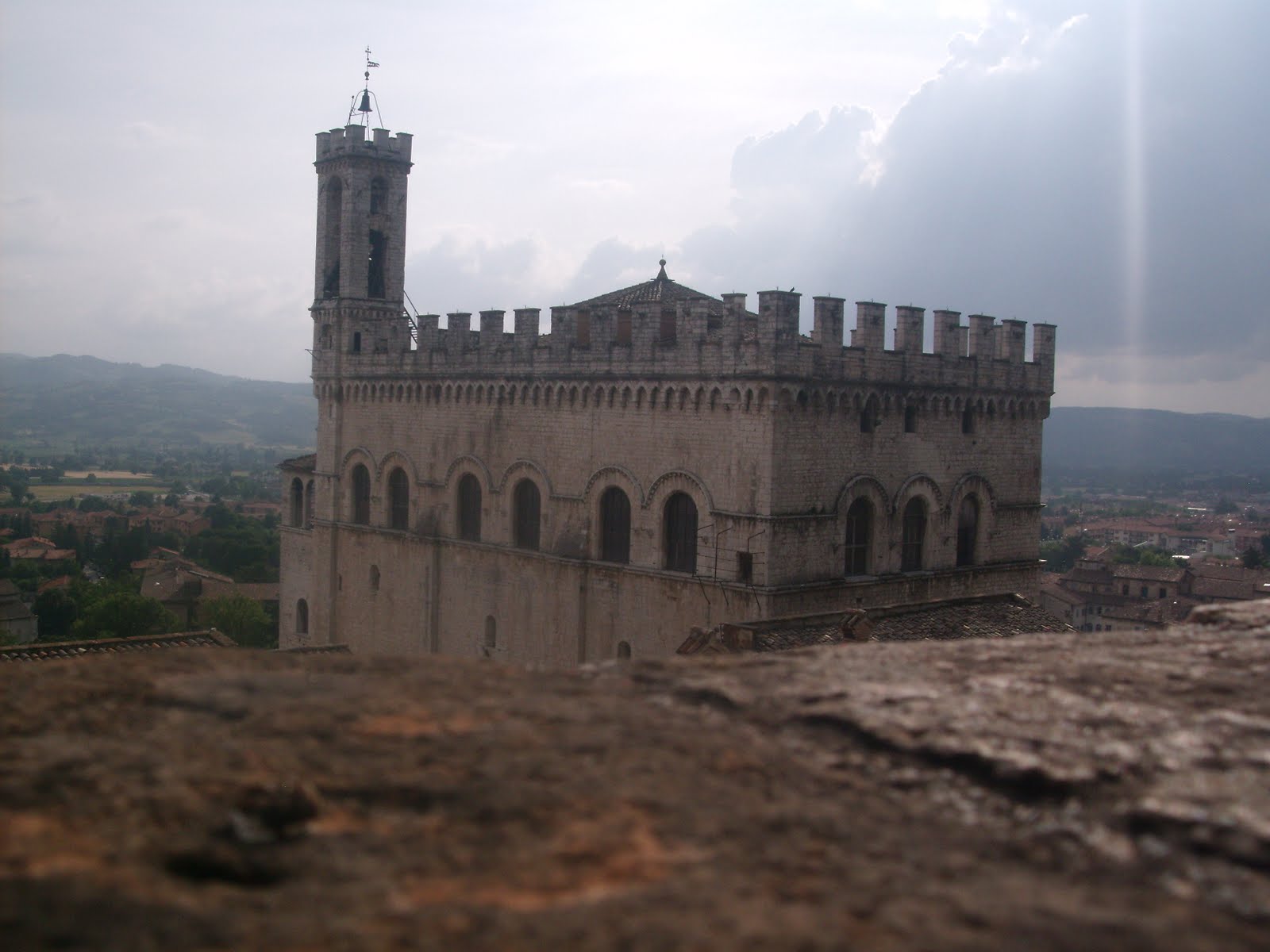
The next day, we took took a cable car up a mountain. But it wasn't a cable car. It was actually a cage that would properly fit one person, though we were fitted two to a 'car'. The cage didn't stop for us as it came round the corner so it was a bit like hopping a train, except for the fact that the cage door also had to be first opened and then closed, once we were inside of it. But oh the glories of gliding up that mountain. Mist in the sky. Poppies in bloom. An medieval city below where every single rooftop had clay shingles. I wished for that ride to last all day. Once at the top, we entered a Basilica, the Basilica of Sant'Ubaldo. I can't begin to describe the churches in Italy. They're all designed to lift our poor spirits from the shadows and into the divine. If it isn't enough that there is incredible frescos and glass windows, throw in a monk singing Gregorian chant or a choir practicing for an upcoming service.


On our way down the mountain, we decided to walk, rather than take the bird cage car. Half way down, we found a small chapel (no big surprise to find random chapels in Italy). There we had a lunch and this time, I properly secured the pesto jar!

Wednesday, June 22, 2011

Venice Discoveries


I promise to be less verbal on this entry. Some of the sweetest discoveries of Venice included walking in the Jewish section of town and discovering lovely art galleries and restaurants. We dined at Gam Gam Kosher Restaurant.

The food was nourishing and delicious. I loved watching families with young children come and go and it felt like a real hub in the community. For supper, we had fish, soup, and latkes with a wonderful apple sauce.

Earlier that day, we had visited the Murano Glass factory on the island. We watched a glassmaker whip up a detailed glass horse, with huge tongs. Tongs so large, I would have used them to pick up a log to toss into a fireplace. I certainly would not have imagined that anyone on this earth could have fashioned the fine details of a horse. Amazing. In the shop, I bought a rosary. It was expensive, naturally, but the blue-coloured beads are incomparable with any other rosary I've seen. I don't know if my prayers will get answered any quicker, but the beads do look lovely wrapped around my fingers. On the way back from the museum, the weather suddenly changed and we found ourselves in a thunder storm, huddled on a boat packed with people. There was nothing to do but allow ourselves to get soaked.


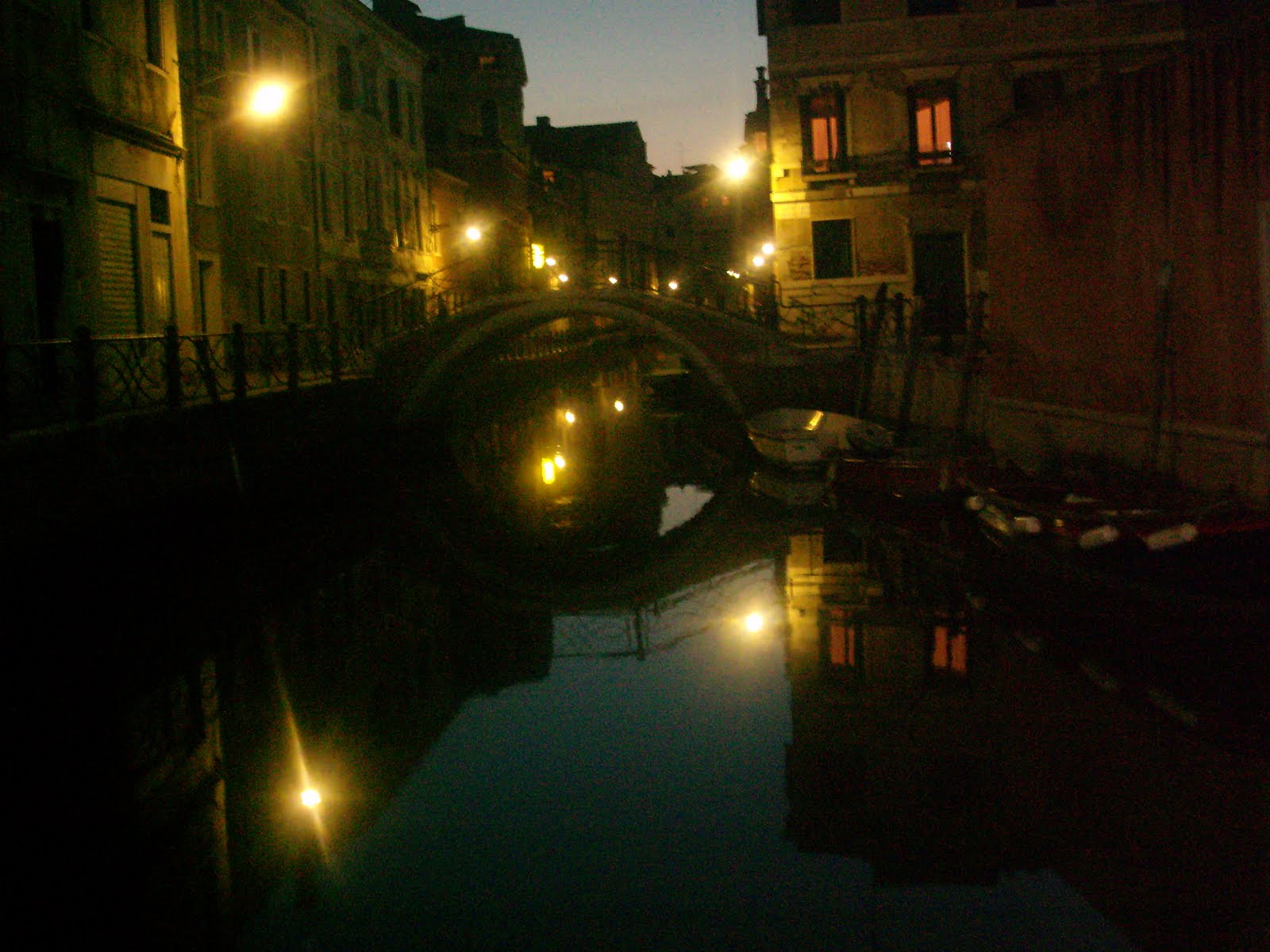
The weather quickly changed, with the sun coming out once again. That evening, we took a midnight, or almost midnight stroll. And this time, we weren't hauling luggage, nor we were in a hurry to make our way to any particular destination. Finally, the romantic city fell on us, like the sweet smell of Jasmine.

Sunday, June 19, 2011

Lost in Venice 1st Post of Travels in Italy


The last time I stepped foot into a country where English wasn't the first language, I was a teenager and backpacking through Europe. My cousin and I, with birthdays only a day apart, traveled for a few months on a budget of $10 a day. I needn't say how long ago that was, but let's just say I was younger than my youngest child. So the memory has receded far into the back of my mind. I know I talked myself into "falling in love" with a Scottish fellow who I met in Spain. I think I loved the notion of being in love more than the actuality of it. But nevertheless, fortunately for me, I once again crossed the ocean and this time landed in Italy. In Venice to be precise.

Everyone told me I would find Venice to be the most enchanting city in the world. And that I would love getting lost in the tiny three-foot wide, cobblestone paths, winding up and around and across tiny bridges and so on. And eventually I did get to that place of wandering around aimlessly and loving the enchantment of it. But initially! Initially, after not sleeping all night long and arriving half dazed and confused, I almost had an anxiety attack. First, we found a bus to take us from the airport to the city of Venice. Once we arrived, we took a water taxi to our hotel, because the google map literally had four pages of arrows turning every which way. (Hard to believe that Google map even attempts to give directions in Venice). So we took the water taxi never thinking for a moment that the 10 or 15 minute ride would sing to the tune of 60 Euro. For only 20 Euro more, we could have taken a gondola ride with a opera singer serenading us! However, after I got over the shock of the 60 Euro, we began to make our way to our hotel. The directions from the water taxi fellow were about as helpful as a frog in a teacup. We walked. And we walked. And the streets were jammed with people. And I was terrified to approach people with my very pathetic attempt at Italian (I got less nervous as time went on.) We dragged our luggage in circles for two hours, asking this person and that person. But no one had heard of the hotel and when I showed them the google directions, that just caused people to shake their heads knowingly. And then, bless this woman's heart, I stepped into one of the many, many tiny shops selling masks. And I asked the woman if she had heard of the hotel. She informed me that I was close, but everyone had informed me in much the same manner. It was always 'just over there', but 'there' was as allusive as a misty midnight drive on a country road. However, this shop keeper was my last hope. She said I needed to follow the 'road' (really a 3 foot wide path) until it ended. Then I was to step under an arch and there I would find the hotel I was looking for. I left the shop and walked in the opposite direction because my husband was waiting for me at a designated spot and she actually called after me "No, no! Wrong direction!" And I answered "My husband is this way." She smiled and all was well. We found our hotel and I loved the tiny room we were given. When I looked out the window, the building opposite to me had laundry strung between windows and I could hear a baby crying. I always relax when I hear a baby cry. We had many amazing days in Venice. And each day, I will post another few drawings from our travels.

Tuesday, May 31, 2011

ten tips for success as an artist


I was asked to give a talk at a conference. The theme of the conference is on developing business skills for artists. I was flattered to be invited as truth be told, I don't consider myself very high up on the ladder of business skills. In fact, in some ways, I am abysmally poor at pulling together the practical elements in my life. But nevertheless, I was invited to speak and it certainly got me to thinking about success. Others may or may not consider me successful in terms of my career as an artist, but the true question is: 'do I see myself as successful?' If I have more than ten people visit my blog in a day, does that define success? If I have a minimum of one play a year produced, is that the definition? Is it a matter of keeping my head above water or is it a matter of thriving? What is it and who decides? Well me, of course. I decide. If I say that one person visiting my blog each year and growing a small garden of rhubarb and keeping on top of my bills defines success, then so be it! And the nice part about it is, whose going to argue with me? My husband has often said "the secret to success is to lower your standards". And though people often chuckle when they hear this, there is a grain of truth to it. But maybe it's not so much lowering standards, as keeping them very flexible.

Well enough, preamble. The following are my ten tips. Hope someone finds them useful. They took thirty-five years to write, after all.

Vision and Reality: The Ever-Changing Landscape of an Arts Practice: Ten Tips by Eleanor Albanese

1) Nurture mentorships; both formal and informal. Be open to intergenerational relationships. There is so much an established artist can benefit from an emerging artist and the reverse is also true. Look to people whom you admire in your field and see if there is potential for working together or hanging out together in a mutually beneficial manner.

2) Don’t wear your knuckles out banging on closed doors. Go where you’re wanted and/or needed. Sometimes we’re so focused on the closed doors that our energy is being depleted with frustration.

3) Give the same quality of work to the low-profile engagements that you would give to high-profile engagements. You never know what growth and good can come out of these ‘humble’ projects. Numbers is not always reflective of the success of a project.

4) Enter each project with the mind of a learner. Be curious. Ask questions. Take time to reflect on what the learning is and try to incorporate that learning into your vision for the future.

5) Everything is worth weighing, considering (and sometimes throwing out the window). Criticism is never easy to absorb, even when it’s offered constructively. As a sensitive person, it may be difficult to get past the initial shock of receiving a blow. A playwright once told me that she reads every review, even the negative ones. She felt that, even if she did not agree with the criticism, there was always one tiny grain of truth to be drawn from it. (Personally, I stay away from the negative reviews but I did appreciate her perspective.)

6) Spend a set minimal amount of time each day engaged in your artistic practice. This will help to keep you current and responsive to the ever-changing arts and culture climate. At certain points in your life, you may be able to give more or less time to your arts practice. However, that minimum daily commitment will keep you connected and alive.

7) Know where your inspiration comes from. And keep a steady stream of it filtering into your life. If you need to be out in nature, then be in out nature. If you need to have late night conversations with friends, then have late night conversations with friends. And be open to that source of inspiration changing, as it very likely will over time.

8) Know what it is you will not compromise in your arts practice. Know your bottom line. It’s a matter of integrity. An artist’s approach to making a living if often different than that of a pure entrepreneur. Though both work toward success, artists need to keep their creative process and works intact. This means something different for every artist. The popular expression “sell out” is a very real phenomenon and by the way, not limited only to the art world. Self-awareness can be an artist’s saving grace.

9) There is no formula to success because success is how you define it. If you define it in such a way that it becomes impossible to achieve, then you may end up feeling like a failure. Or, conversely, an artist may achieve ‘success’ in the world, but has compromised something else of value such as health or family life and so on. Success is not a straight-forward thing. In fact, most of the time “success” happens in such an organic way that we don’t even recognize it.

10) Set goals each year. In goal-setting, include aspects of life other than artistic. That way, the goals you set will be balanced with everything else of importance to you. And if you don’t accomplish a goal one year, there’s always next year!


As you can see, I've also included two photographs of the balcony landing a few weeks ago when all the blossoms had dropped. It was so beautiful, almost like snow. For me, that's a creative moment; the moment of seeing those petals.

Monday, May 23, 2011

Lilacs and barefoot brides


It is spring. The smells are glorious, wafting in on the breeze from the lilac bush just outside my front window. Wherever I've lived, I've always been blessed with lilac bushes to welcome me into spring. When I was just eighteen, my best friend was getting married. It was 1975 and she wore bare feet up the aisle, carrying lilac blossoms, much to the complete dismay of her parents. She insisted on lilacs for her flower arrangements and most years, lilacs would have been ready for a June wedding. But not the year Beth got married. That year, spring came late. Still, she would not agree to buy florist flowers. Rather, she phoned her cousins who were travelling up from Minneapolis and asked them to pick lilacs for her wedding day. Which they happily agreed to. After the wedding, the three of us bridesmaids, dressed in golden muslin embroidered dresses, took pictures of each other in the park by the fountain. We were so young. Yet even at the age of eighteen, a half dozen of my closest friends were either married or had children or both. I feel lilacs connect me to those years of innocence. There were hardships in the world then too. But we hadn't entered yet the era of “environmental justice”. I didn't know a time would come when I would grieve for this earth and the damage that's been done to her. I didn't know that I would feel compelled to create a film that would be my own offering to the future of our earth (titled “Under the Pearl Moon”).


I don't expect I'll ever return to the days of barefoot brides and muslin bridesmaids dresses. But lilacs do return each year. As too does my gratitude for this incredible earth we're so privileged to live in.

Sunday, May 15, 2011

Choco- Zucchini Gluten-free muffins and Red Rose Tea


I was visiting my mother this past weekend and I was thinking about the 1950's housewives I grew up with. The women on our neighbourhood block were community-builders and cooks and seamstresses. They sewed and made doll's clothes and most of all, they looked out for each other's children. I know that it wasn't easy for many of them. Some, I'm sure, felt they had unused talents and wished they'd had more opportunities. I know that many worked from morning until night and barely recovered from one pregnancy before they found themselves pregnant again. That certainly was the case in my neighbourhood where the women had anywhere from seven and thirteen children.

For years I didn't think twice about my mother's role as housewife. Yet now I think about it with great admiration for her. She was incredibly resourceful and "made do" in so many situations. She and her friends were what I call "the red rose tea generation". Because they were so happy to simply sit with a cup of tea. They were satisfied with a two-day old tea biscuit or a slice of cinnamon toast with their tea. They were down-to-earth women who delighted in simple pleasures. And they were not consumers at all, not in the way we are consumers today.

Here is my latest version of gluten-free muffins. Because of my mother, I experiment in the kitchen. Because of my mother I sew, I croquet, I make clothes, I make art and sometimes I even "make do". If you like these muffins, you may want to try them with a cup of red rose tea.... like I did this week with my mother.

Choco-Zucchini Gluten-free muffins

Wet:
two eggs
1/2 cup soy milk or rice milk
1/2 cup yogurt (may use soy yogurt)
1/2 cup honey
1/2 cup melted butter
2 tsp. vanilla extract
1 cup grated zucchini

Dry:
1/2 cup quinoa flour
1/4 cup teff flour
1/2 cup millet flour
1 cup rice flour
2 Tablespoons cocoa powder (try Green and Black's organic0
1 Teaspoon cinnamon
1/2 tsp. baking soda
2 tsp. baking powder

Mix dry into wet. Add 2/3 cups chocolate chips. Place into greased muffin tins. Put one large walnut on top of each muffin. Bake at 350 for twenty minutes or so. These muffins are very moist and are best if kept in the fridge after cooling. As with all gluten-free baking, the shelf life is short, so I often freeze half the batch.

Tuesday, May 3, 2011

Lucy Snowe and Alzheimer's


I see that often, at the time of day where I reflect on this or that, one of my creative impulses is to take two seemingly disconnected elements in my day and draw a thread between the two. Like yesterday; the threads consisted of a passage from Charlotte Bronte's novel “Villette” and with my aunt who has Alzheimer's.

The character in the book, Lucy, arrives into a foreign country late in the evening, having lost her overnight bag, and only a few coins to her name. A kind stranger emerges to offer her an act of kindness. And, at his invitation, he guides Lucy Snow to an inn, “ ...the park was black as midnight. In the double gloom of thick and fog, I could not see my guide; I could only follow his tread. Not the least fear had I: I believe I would have followed that frank tread, through continual night, to the world's end“. I was reading this section of the Lucy's story on my long underground subway ride, on my way out to visit my aunt who now lives in a senior's home. I hadn't seen her since last summer and her struggle with Alzheimer’s disease has advanced much further along over the winter. Though she did not recognize me, she welcomed me with a kiss, the way she's always welcomed me. I am reminded that, in spite of the fact that she raised nine children, myself and my sisters and brothers were always welcomed into her home. There was never any question of how long we might stay and how burdened she might already be (given that she was almost always in a state of pregnancy or nursing a small child). No matter. Beds were rearranged, pillows were found, an extra handful of pasta was thrown into the pot. We were family and clearly, that's all that mattered to her.

Today, my aunt and I cannot reminisce on those days so long ago. Nor can I ask her about her dozens of grandchildren. I begin conversations about this or that, but she isn't able to respond in a way that is comprehensible to me. Most of what she says does not make sense, at least not in the way that I normally like to make sense of things. But strangely, as I listen to her speak, I find myself interpreting her words, as though I were in a foreign land like Lucy Snow. I try to sense out what it is she is saying to me. And whatever it may be, it is, without a doubt, all kindness and goodness. I believe if I could somehow unscramble her words, I would hear her asking me about my children and my day-to-day life. She would tell me how lovely I looked, or compliment my hair or comment on something I was wearing. She would laugh easily and sympathize deeply.

When she and I stood at her window looking outside, I noticed how the trees were just beginning to open up to the possibility of Spring. Among the trees stood a white statue of Mary, gleaming out, as if lit from within. My aunt and I said three “Hail Mary's” together. Amazingly, having said that prayer, likely tens of thousands of times in her life, the words flowed like a song from her lips. And for a brief moment, we shared the same language.

From the outside looking in, a person could say that I did a kind deed by visiting an aunt who no longer recognizes me. But I would not agree. I would say that by visiting her, I was the one who was gifted. I was able to step outside of my everyday problems and all the things that uselessly preoccupy my thoughts, and leap into something not quite comprehensible to me.... into the unknown. Like Lucy Snow who, without resources, travels to a foreign land and relies on the good will of a stranger to deliver her to safety. She follows him by sound, not by sight. Perhaps, that is where my aunt is right now, in a foreign land. Or, perhaps the rest of us exist in that foreign land. Either way, we can help each other through the “double gloom of thick and fog” by listening beyond language, beyond words, even beyond shared memories. It's not easy, of course. And I would not begin to presume the challenges I would face if she were my own mother. But from the perspective of a niece who loves her in my own way, I can appreciate the gift she gave me in those brief hours.